What Does a Yield Sign Mean in California? Right-of-Way Rules and Who Is at Fault
Home / What Does a Yield Sign Mean in California? Right-of-Way Rules and Who Is at Fault
This page was written and reviewed by Michael J. Cefali, Esq. Attorney Cefali is a founding partner of Cefali & Cefali, APC, based in San Juan Capistrano, CA. He holds a Juris Doctor from Chapman University Fowler School of Law and a B.A. in Global Studies & Maritime Affairs from the California Maritime Academy. Widely recognized for his advocacy in personal injury law, he has secured multi-hundred-thousand-dollar settlements in motorcycle accidents, hit-and-runs, and red-light collision cases. He maintains a perfect 10.0 “Superb” rating on Avvo.
Beyond his legal practice, Mr. Cefali actively supports his community through the Rotary Club of San Juan Capistrano, contributes to housing and meal programs for those in need, and enjoys fishing and spending time with his rescue dogs.
The date below reflects when this page was last reviewed for accuracy. Please see our Editorial Guidelines.
What Does a Yield Sign Mean in California? Right-of-Way Rules and Who Is at Fault
A yield sign means you must slow down, be ready to stop, and let any vehicle or pedestrian that is already in the intersection, or close enough to be an immediate hazard, go first. In California, Vehicle Code section 21803 requires the driver facing the sign to keep yielding until it is reasonably safe to proceed, and a driver who fails to yield and causes a crash is usually found mostly or fully at fault.
This guide covers what the sign requires, when you actually have to stop, what "yield the right-of-way" means in different situations under the Vehicle Code, and how fault is decided after a failure-to-yield crash. Hit by a driver who ignored a yield sign or right-of-way rule? Cefali & Cefali reviews these cases free at (949) 325-7790. The guide explains the law generally; your own facts can change how it applies.
What does a yield sign mean?
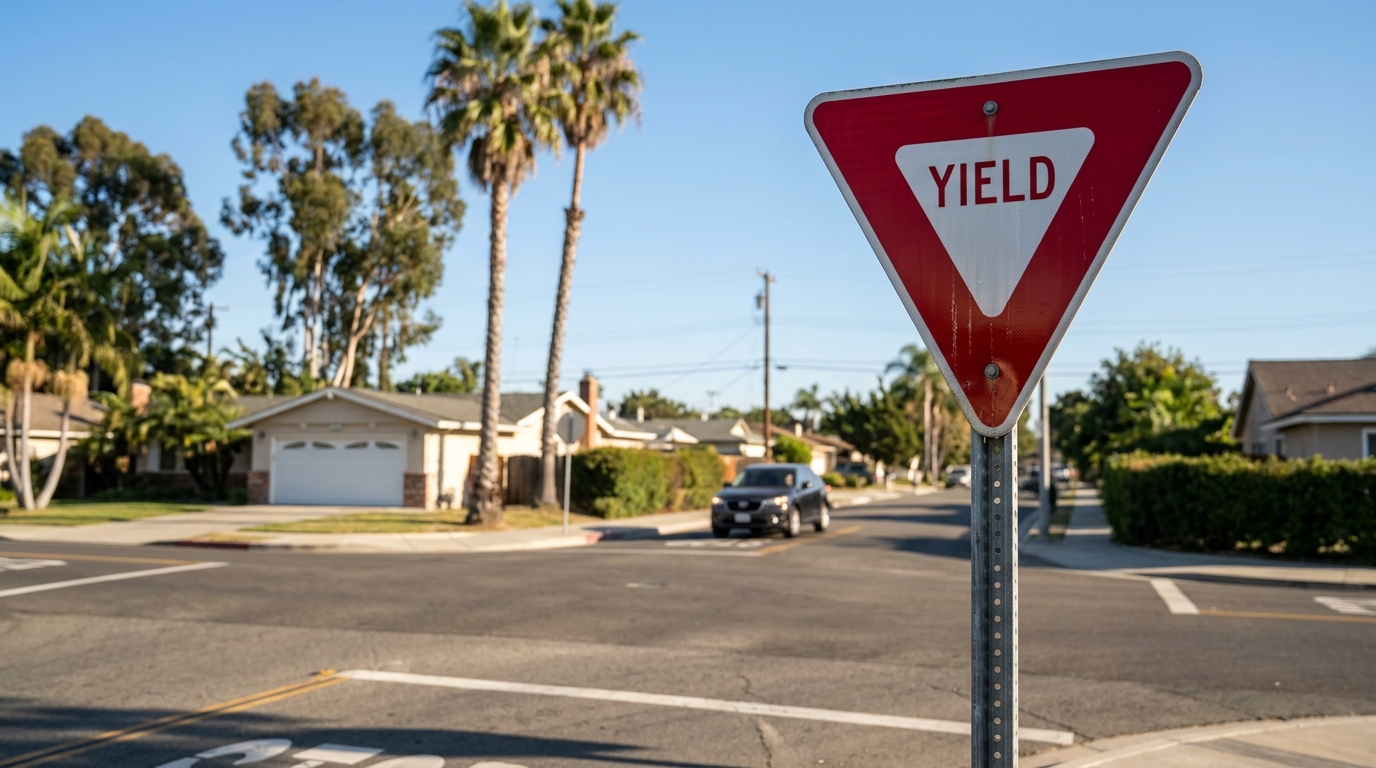
A yield sign tells you that the cross traffic has priority: slow down, look, and give way to vehicles, bicyclists, and pedestrians before you enter. It is the red-and-white, downward-pointing triangle with the word YIELD, and it appears at intersections, freeway on-ramps, roundabout entries, and merge points.
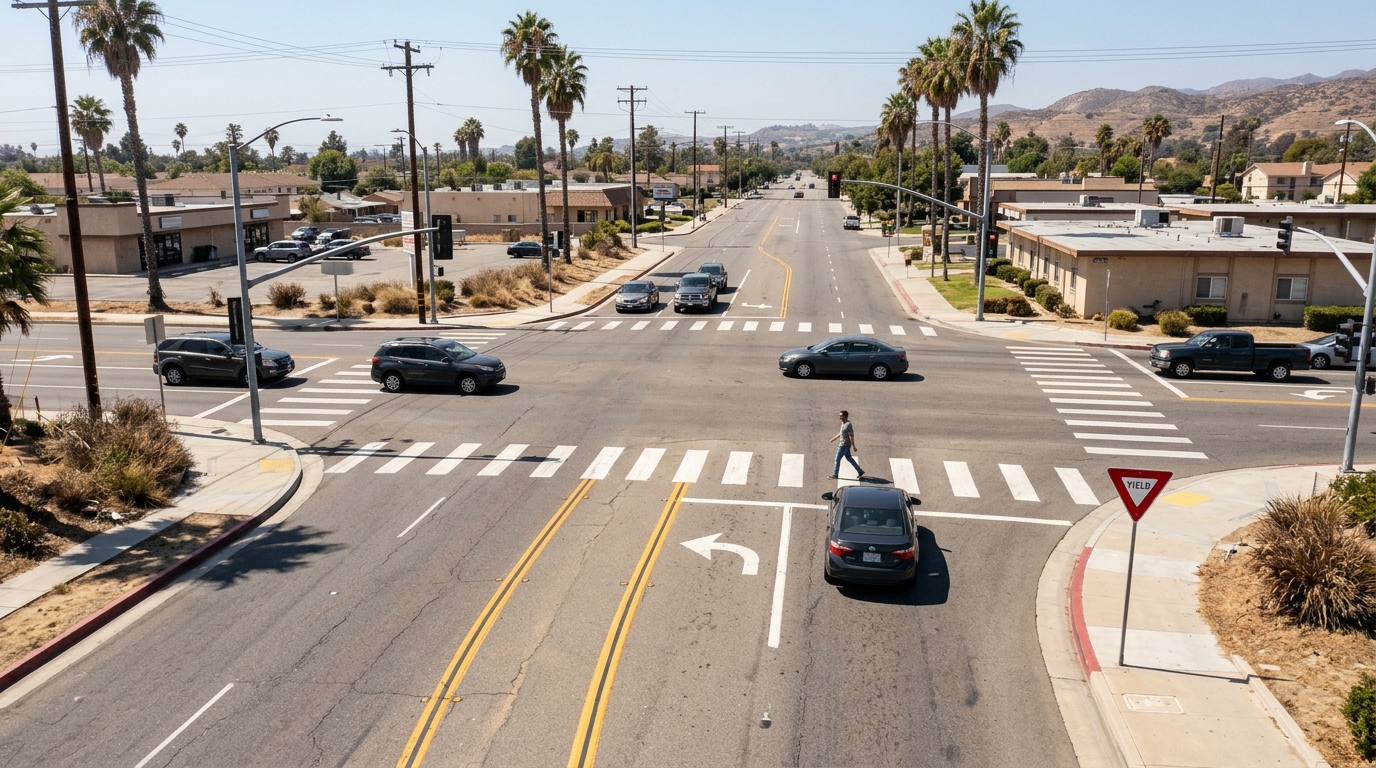
Under section 21803, a driver approaching an intersection controlled by a yield sign must give way to every vehicle that has already entered the intersection from the other road and to any vehicle approaching closely enough to be an immediate hazard. Once that driver has yielded and can go safely, section 21803(b) flips the duty: approaching drivers must then let the vehicle that has entered finish crossing.
Failing to yield is an infraction. A conviction generally adds one point to your driving record under Vehicle Code section 12810, along with a fine and court assessments, and points can raise insurance rates.
Do you have to stop at a yield sign?
No, not always. A yield sign does not require a full stop the way a stop sign does; section 21803 does not use the word "stop." You must stop only when cross traffic or pedestrians are close enough that entering would be unsafe, and you stay stopped until a safe gap opens.
Clear road: slow down, check both directions, and continue without stopping.
Traffic approaching or a pedestrian in the crosswalk: stop, usually at the limit line or before the crosswalk, and wait for a safe gap.
Limited visibility: slow to a crawl or stop until you can see far enough to be sure the way is clear.
Can you stop at a yield sign if the road is clear?
Stopping at a yield sign is not illegal, and stopping is always better than pulling into traffic you cannot see. But an unexpected full stop on an empty road can surprise the driver behind you. If that driver hits you, the rear driver is usually at fault for following too closely under Vehicle Code section 21703; rear-end collision fault in California covers the exceptions. A stop with no traffic reason can still lead to shared fault arguments, which our article on brake checking explains.
What does yield the right of way mean?
Yielding the right of way means letting another road user go first when the law gives them priority. Vehicle Code section 525 defines right-of-way as the privilege of the immediate use of the highway, and the Vehicle Code assigns that privilege situation by situation.
Situation
Who must yield
Vehicle Code section
Yield sign at an intersection
Driver facing the sign yields to vehicles in or close to the intersection
21803
Uncontrolled intersection, arriving at different times
The later-arriving driver yields to the vehicle already in the intersection
21800(a)
Uncontrolled intersection, arriving at the same time
Driver on the left yields to the driver on the right
21800(b)
T-intersection with no signs
Driver on the road that ends yields to traffic on the through road
21800(b)
All-way stop, arriving at the same time
Driver on the left yields to the driver on the right
21800(c)
Traffic signals dark or not working
Stop first, then treat it like an all-way stop
21800(d)
Two-way stop
Driver at the stop sign stops, then yields to cross traffic
21802
Left turn or U-turn
Turning driver waits until oncoming cars are far enough away to complete the turn safely
21801
Entering from a driveway, alley, or parking lot
Entering driver yields to traffic on the road
21804
Pedestrian in a marked or unmarked crosswalk
Driver yields to the pedestrian
21950
Pedestrian crossing outside a crosswalk
Pedestrian yields to vehicles
21954
Emergency vehicle with siren and red lights
Drivers pull to the right and stop
21806
Roundabout entries in California are usually marked with yield signs, so drivers entering yield to traffic already circulating. On freeway on-ramps, the merging driver must not move over until it is safe, under Vehicle Code section 21658.
Yielding to pedestrians
Vehicle Code section 21950 gives pedestrians priority in marked crosswalks and in the unmarked crosswalks that exist at most intersections, and drivers have to slow down and take care as they approach. Pedestrians have duties too: stepping off the curb right in front of a car that has no room to stop is prohibited. Our guide to California pedestrian right-of-way law covers these rules, including how they apply outside crosswalks.
When should you yield your legal right of way?
Whenever insisting on it would cause a crash. Having the right of way does not excuse careless driving; every driver still has a duty of reasonable care, and a driver who sees a collision coming and could have avoided it can share the blame. If another driver runs a yield sign in front of you, slowing down or stopping is safer than proving a point.
Who is at fault in a failure-to-yield crash?
The driver who had the duty to yield and failed to do so is usually primarily at fault. Officers often cite that driver at the scene, and breaking a right-of-way statute such as section 21803, 21801, or 21804 triggers a presumption of negligence under Evidence Code section 669 that the driver must then rebut.
Fault is not always one-sided. Since Li v. Yellow Cab Co., 13 Cal.3d 804 (1975), California has used pure comparative fault, so each driver's share is weighed and each recovery is reduced by the injured person's own percentage. Our guides to how fault is determined in a car accident and pure comparative fault explain the process.
The driver with the right of way was speeding. Excessive speed can make a gap look safe when it was not and can shift part of the fault to that driver.
The driver with the right of way was distracted or impaired. A driver who could have avoided the crash by paying attention can share fault.
The yield sign was missing, faded, or hidden. A city or county is generally not liable just because it never installed a yield sign, under Government Code section 830.4, but a sign that was knocked down or blocked by overgrown landscaping can support a dangerous-condition claim under Government Code section 835. That route requires a written claim to the agency inside six months (Government Code section 911.2).
A pedestrian stepped out suddenly. A pedestrian who leaves the curb directly in front of a car that cannot stop may share fault under section 21950(b).
Dashcam, traffic camera, and nearby business or doorbell video.
Witness statements describing which car entered first and how fast each was going.
Vehicle damage patterns, such as a side impact on the car that had the right of way.
Event data recorder information showing speed and braking before impact.
Photos of the intersection, the sign, sight lines, and any obstructions.
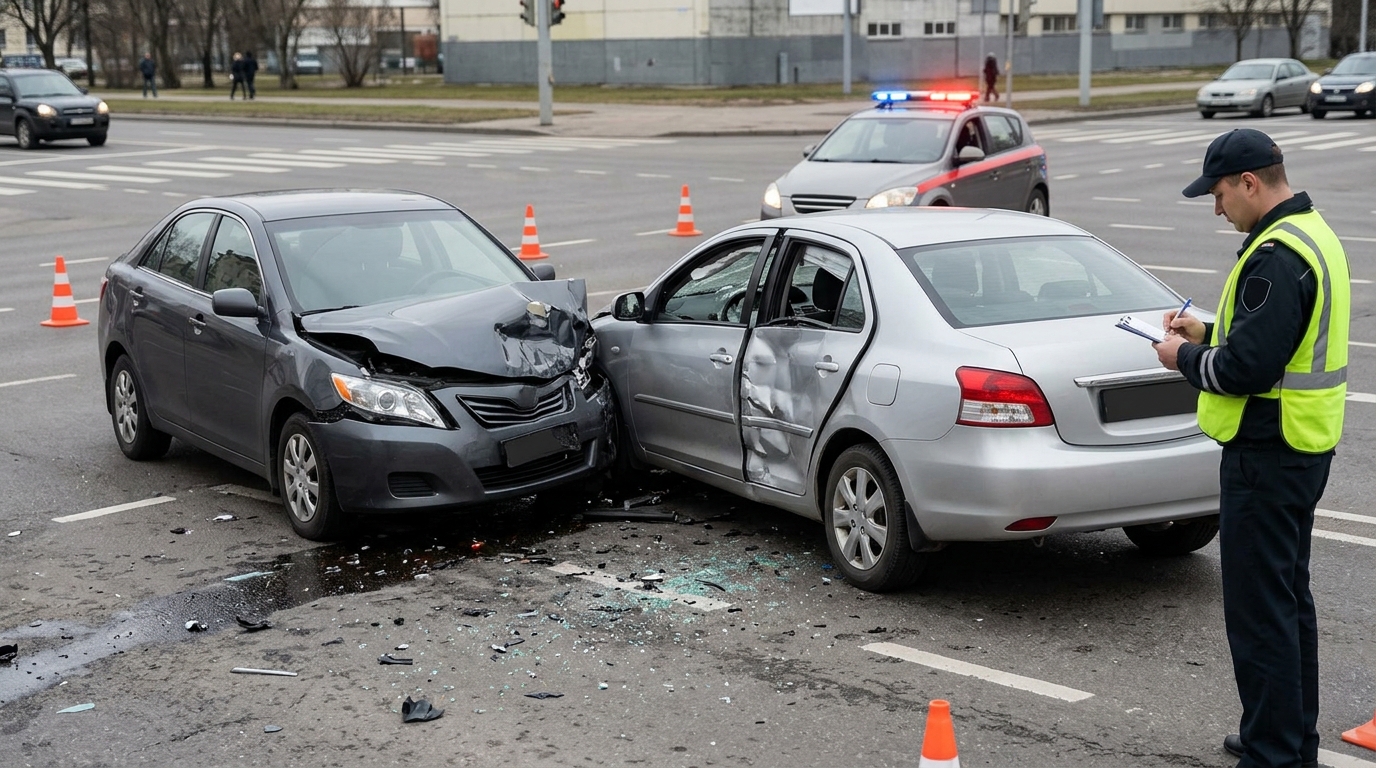
Failure-to-yield crashes are often T-bone or left-turn collisions, which can cause serious injuries because the side of a car offers little protection. Recoverable losses include treatment costs, missed income, and physical and emotional suffering, as outlined in economic vs. non-economic damages. The window to sue for injuries is usually two years from the collision (Code of Civil Procedure section 335.1).
Frequently asked questions
What does a yield sign mean?
It means slow down, be ready to stop, and give way to vehicles and pedestrians already in the intersection or close enough to be an immediate hazard. California Vehicle Code section 21803 requires you to keep yielding until you can proceed safely.
Do you have to stop at a yield sign?
Only when traffic or pedestrians make it unsafe to continue. A yield sign does not require a full stop when the way is clear, but you must stop and wait if entering would put you in the path of approaching traffic.
What does yield the right of way mean?
It means letting another driver, cyclist, or pedestrian go first when the law gives them priority. The Vehicle Code sets right-of-way rules for intersections, left turns, driveways, crosswalks, and emergency vehicles.
Who is at fault in a failure-to-yield crash?
Usually the driver who failed to yield, because violating a right-of-way statute creates a presumption of negligence. Fault can be shared if the other driver was speeding, distracted, or could have avoided the crash, and California reduces each recovery by the injured person's percentage of fault.
Talk to a lawyer about a failure-to-yield crash
When another driver ignores a yield sign or a right-of-way rule, the evidence of who entered first can disappear quickly. Cefali & Cefali can secure video and witness statements, deal with the insurers, and pursue compensation for your injuries. There is no fee unless we recover. Start with a free call to (949) 325-7790, or describe the crash through our online form.
Michael Cefali is a dedicated accident attorney based in San Juan Capistrano, California, committed to securing justice and fair compensation for accident victims.
A graduate of Newport Harbor High School, he went on to earn his Bachelor’s degree in Global Studies and Maritime Affairs from the California Maritime Academy, followed by his Juris Doctor from Chapman University School of Law.
Deeply invested in his community, Michael is an active member of the Rotary Club of San Juan Capistrano, contributing to efforts that provide meals, housing, and support to those in need. Outside of his legal work and volunteer service, he enjoys fishing in Dana Point and spending time with his three rescue dogs—a Chihuahua, a Spaniel mix, and a Shepherd mix.
Driven by his strong belief in justice and fairness, Michael remains steadfast in advocating for individuals harmed by the negligence or inaction of others.
Search Our Site
Schedule Your FREE Consultation
"*" indicates required fields
Practice Areas
Follow Us
Why Choose Cefali & Cefali Personal Injury Lawyers
We litigate and the insurance companies know it.
Unparalleled client communication leads to better results.
Down to earth attorneys who listen and care.
We get great results.
We have a fantastic team of paralegals and other friendly support staff.
We take the tough cases other firms reject.
No out of pocket - no win no charge.
100% free consultation
Contact Us Today
Start your no-obligation consultation with us by filling out the form below and we will contact you about your case within 24 hours.